Kioxia Iwate to Evaluate Nagoya University’s GaN-Based e-Beam Inspection Technology for Advanced Semiconductor Manufacturing
It was recently announced that GaN (Gallium Nitride)-based e-Beam inspection and metrology technology, jointly developed by Nagoya University startup Photo electron Soul Inc. and the Nagoya University Amano-Honda Laboratory, will undergo evaluation at Kioxia Iwate Corporation in late September. This upcoming field test will focus on assessing and validating the advantages of deploying this advanced inspection system in semiconductor manufacturing, with the goal of enhancing overall production yield through improved defect detection and root-cause analysis in live inspection and metrology workflows.
As 3D flash memory continues to evolve, its defining feature—a memory cell stacked structure—poses new challenges to fabrication. With increasing numbers of layers and ever-higher integration, Kioxia has been actively working to develop and refine inspection and metrology techniques that can keep pace with these manufacturing complexities.
The technologies now under Kioxia’s evaluation—photocathode e-Beam inspection and photocathode e-Beam metrology—address critical needs in the industry. They make it possible to perform non-contact electrical inspection, detect hidden defects, and conduct detailed profile measurements within the deep regions of high-aspect-ratio structures, areas where conventional approaches struggle to deliver accurate results.
At the heart of this innovation lies GaN-based photocathode e-Beam technology, featuring two distinctive methods: DSeB (Digital Selective e-Beaming) and YCeB (Yield Controlled e-Beaming). These techniques enable a new generation of semiconductor inspection by allowing selective e-Beam radiation and real-time beam intensity control, effectively eliminating the risk of beam misalignment and ensuring high precision throughout the process.
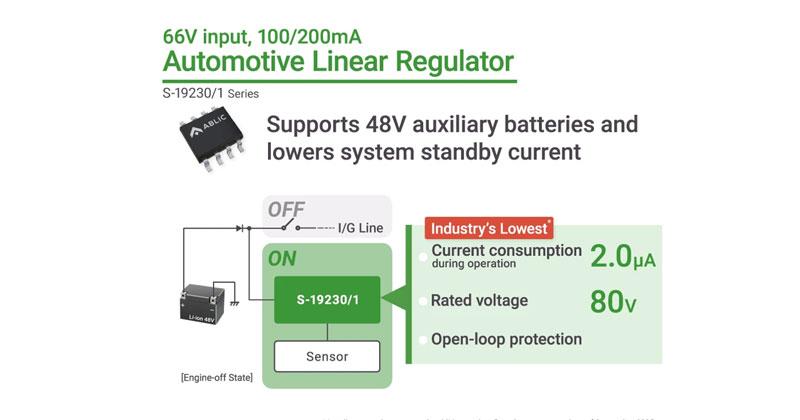
Key Highlights of the S-19230/1 Series
- Unprecedentedly Low Current Consumption: Achieves an operating current of just 2.0µA, effectively lowering standby current in automotive systems where sensors and transceivers must operate continuously.
- High Input Voltage Endurance: With an input tolerance of up to 80V, the device accommodates 48V battery systems and, for applications with an output current of 10mA or less, it also supports 24V and 12V systems with a minimum operating voltage of 3.0V.
- Integrated Open-Loop Protection Circuit: Provides automatic suppression of abnormal voltage rise in the case of wiring faults, removing the necessity for external protection components and enabling safer, more compact, and cost-efficient designs.
- Automotive-Grade Reliability: Subjected to three-temperature testing (low, normal, and high), the regulator is being prepared to meet the rigorous AEC-Q100 standards established by the Automotive Electronics Council. PPAP (Production Part Approval Process) support is also planned, ensuring suitability for demanding automotive environments.
With the introduction of the S-19230/1 Series, ABLIC strengthens its portfolio of automotive power solutions, delivering regulators that are not only energy-efficient and compact but also aligned with the growing shift toward higher voltage vehicle architectures.