Allegro Microsystems Unveils 10 MHz Current Sensor for WBG Power Design
Allegro MicroSystems has developed a new current-sensing platform aimed squarely at the challenges of wide bandgap devices like GaN and SiC FETs. While these devices are reshaping how power systems are built—they switch faster, run cooler, and can deliver higher power density than silicon—their speed also pushes traditional sensors to the edge of their limits. Accurate, low-latency current feedback is essential for stable control loops, yet many existing magnetic sensors can’t keep up once switching speeds climb past a few megahertz. The result can be instability, noise, or even device damage, issues that limit how much efficiency these materials can truly deliver.
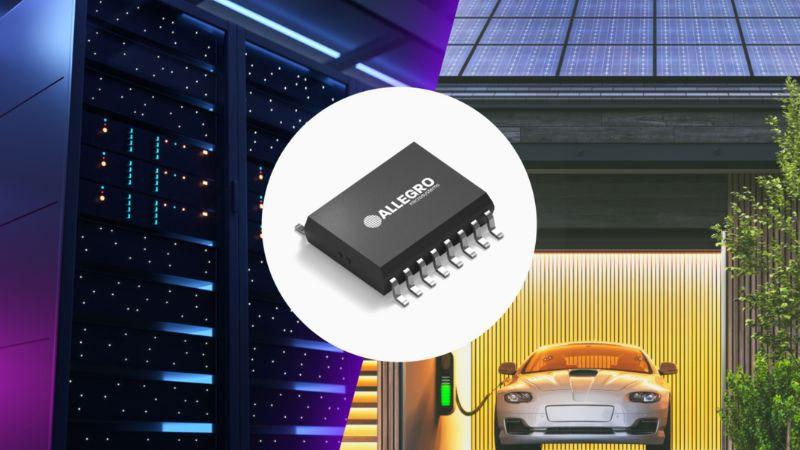
The Allegro ACS37100 TMR current sensor delivers 10-MHz bandwidth and 26-mA RMS noise for high-speed GaN and SiC power systems.
Allegro MicroSystems built its new ACS37100 on the company’s XtremeSense tunneling magnetoresistance (TMR) technology. Allegro claims it is the first magnetic current sensor in production to reach a 10-MHz bandwidth. With a 50-nanosecond response time and 26-mA RMS noise floor, it provides the clean, real-time signal that GaN and SiC power stages need for precise switching, protection, and control.
Built for Fast, Wide Bandgap Power Systems
As GaN and SiC transistors continue to push switching frequencies higher, feedback latency becomes a limiting factor in converter design. The ACS37100’s 10-MHz analog output tracks high-speed current changes directly, giving controllers accurate data without the lag or filtering delay typical of Hall-based sensors. This makes it well-suited for DC-DC converters, EV on-board chargers, clean-energy inverters, and AI data center power supplies, where control precision and power density go hand in hand.
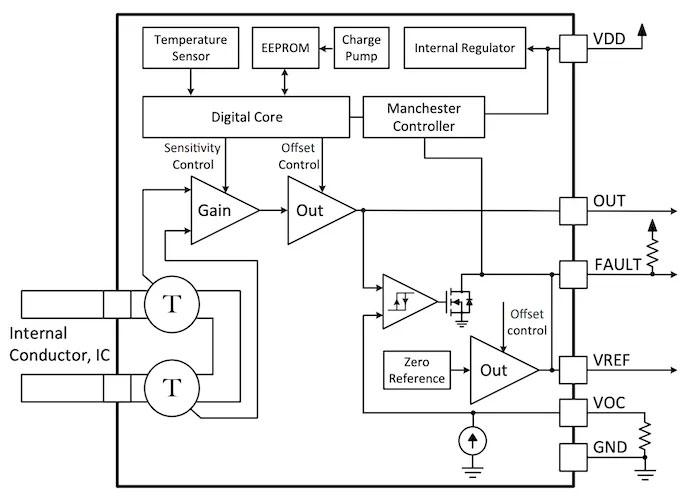
Simplified block diagram of the ACS37100 showing internal TMR sensing elements, amplifier chain, and fault-protection circuitry.
Because the sensor’s noise stays low (about 26-mA RMS over its full range), engineers can detect even small current changes without adding heavy digital filtering. That means tighter control and faster fault reaction, both critical when guarding GaN and SiC switches from overcurrent spikes that happen in just microseconds. A built-in adjustable FAULT output offers immediate shutdown capability, helping prevent device failure in high-voltage circuits.
Performance and Isolation
The ACS37100 (datasheet linked) pairs high bandwidth with strong electrical isolation for use in high-voltage systems. It provides 5 kV isolation under UL 62368-1 and keeps 8 mm of creepage and clearance within its small SOICW-16 package. Inside, a 1.2 mΩ conductor helps cut loss and heat, keeping current measurements accurate even in tight circuit layouts. A VREF output supports differential routing in noisy environments, further improving signal integrity in compact or high-frequency systems.
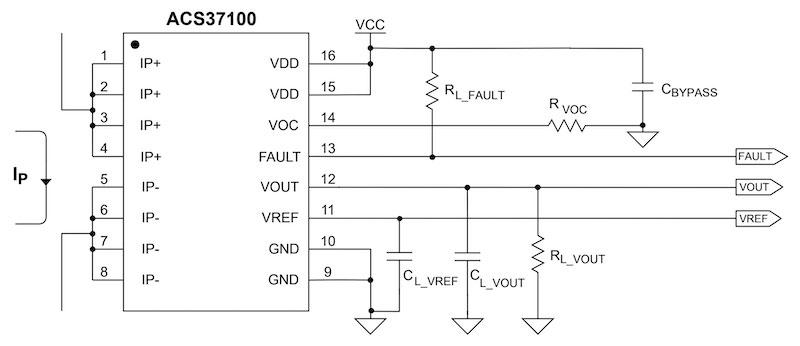
Typical application circuit of the ACS37100.
Rated for -40°C to +150°C operation and AEC-Q100 Grade 0 automotive qualification, the device can operate reliably in harsh thermal and electrical conditions. That makes it a good choice for power systems used in electric vehicles, solar equipment, and industrial drives where accuracy and long-term reliability matter.
Why It Matters
In practical terms, the ACS37100 bridges a long-standing gap in the signal chain for wide bandgap power converters. Its combination of 10 MHz bandwidth, low noise, and fast response gives engineers real-time current visibility without sacrificing isolation or safety margins. By providing clean analog feedback in systems using GaN and SiC FETs, it enables higher efficiency, better transient response, and improved reliability—all key goals for the next generation of compact, high-performance power electronics.