Nexperia Delivers MOSFETs With More Power in Less Space
Car makers are chasing every ounce of efficiency they can get, forcing them to reconsider power electronics design. The old 12 V subsystems are becoming less prevalent than the new 48 V setups, which promise lighter wiring, better energy use, and a longer driving range for hybrid and electric platforms.
However, moving up in voltage brings its own headaches. How do you push more power through without ending up with bulky circuits or devices that run too hot?
Nexperia aims to make that juggling act easier with its new 100 V MOSFET lineup built into the compact copper-clip package. These devices are qualified for automotive use and hit impressively low conduction losses, with on-resistance dipping to just 0.99 milliohms, all while carrying currents north of 460 A. And, because the package measures only 12 x 12 mm, it packs plenty of power density into a small footprint, cutting down the need for multiple parallel devices and giving engineers back precious PCB space.
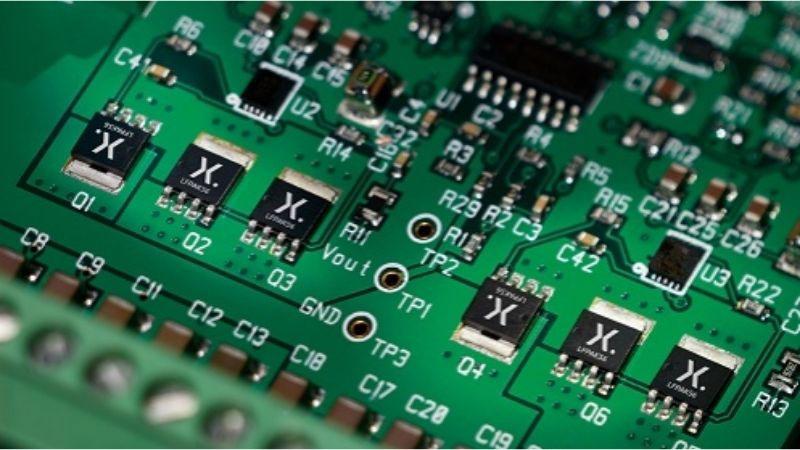
Compact 100 V MOSFET designed for efficient 48 V automotive systems. Image used courtesy of Nexperia
Meeting 48 V System Demands
The shift to 48 V architectures is not a passing trend, as many automakers are standardizing on higher-voltage systems to meet the growing system demands, such as onboard chargers, traction inverters, and battery management systems, since even minor conduction losses can snowball into higher heat, reduced driving distance, and larger cooling loads.
By leveraging its trench silicon platform and proprietary copper-clip packaging, Nexperia has pushed conduction losses down while also improving thermal performance. With a thermal resistance (Rthj-b) as low as 0.1 K/W, the CCPAK1212 package allows heat to move away quickly, keeping components reliable under heavy loads. Compared with bulkier TOLL or TOLT packages, the new devices can save up to 40% of PCB space, a tangible win for engineers chasing tighter layouts.
Design Flexibility Through Cooling Options
Recognizing that not every system has the same thermal strategy, Nexperia offers the MOSFETs in two package variants: the bottom-side cooled CCPAK1212 and the inverted top-side cooled CCPAK1212i. This choice allows engineers to integrate the devices, whether pulling heat into the board or directing it toward a heatsink. The MOSFETs have the same small footprint, but the two cooling styles let engineers route heat differently depending on the desired system.
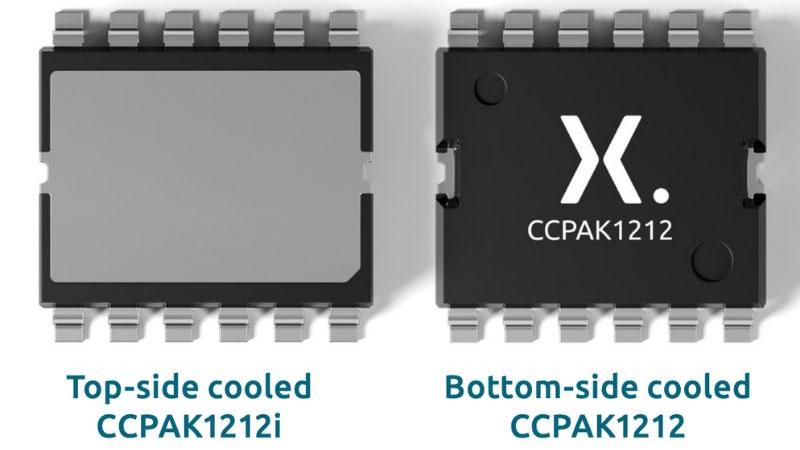
Two cooling styles, one compact footprint: CCPAK1212i (top-side) and CCPAK1212 (bottom-side). Image used courtesy of Nexperia
With ratings up to 1.5 kW, the MOSFETs provide a robust safe operating area, allowing them to withstand high inrush currents and surges without failure. That resilience is essential for applications such as belt starter generators, DC-DC converters, or the synchronous rectifiers in onboard charging systems. For electric scooters, motorcycles, and three-wheelers, where space is even more constrained, combining a small footprint and high thermal reliability can be decisive.
Designed for Industrial Applications
Although designed with automotive in mind, the MOSFETs are equally suited for demanding industrial uses. High-power brushless DC motor control, energy storage systems, and hot-swap communication infrastructure can all benefit from the low resistance and thermal efficiency of the CCPAK1212 platform. In renewable energy storage or telecom power modules, where uptime and reliability are paramount, the devices promise efficiency gains and longer service life. By maintaining AEC-Q101 qualification across the product line, Nexperia ensures the same level of reliability for both automotive and industrial customers.
A Building Block for the Next Generation
With on-resistance dipping below a milliohm, current capacity above 460 A, and compact packaging that saves up to 40% of PCB area, Nexperia’s 100 V MOSFETs offer a strong combination of performance and practicality. For automotive engineers wrestling with the space and thermal limits of 48 V systems, the CCPAK1212 package is more than a minor update. It is a way to design smaller, cooler, and more efficient power electronics without stacking devices in parallel.
These MOSFETs can help engineers tired of juggling space, heat, and efficiency all at once. They provide more current in less space, cut down parts, and keep thermal worries in check. In a world where everything from scooters to SUVs is going electric, that simplicity is exactly what designers have been asking for.