Analog Devices Unleashes CodeFusion Studio 2.0, Elevating Embedded AI and Multi-Core Development
In a significant update aimed at accelerating innovation at the edge, Analog Devices, Inc. (ADI) today launched CodeFusion Studio 2.0. This release marks a substantial evolution from the open, extensible toolchain detailed by All About Circuitsearlier this year, deeply integrating artificial intelligence (AI) development capabilities directly into the Microsoft Visual Studio-based platform. The enhanced IDE now delivers seamless compatibility across ADI's diverse range of embedded processors, from microcontrollers (MCUs) to system-on-chips (SoCs).
CodeFusion Studio 2.0 provides a unified environment for AI development and multi-core debugging.
Version 2.0 focuses on two primary advancements: a streamlined, end-to-end AI development and deployment workflow, and a powerful unified environment for managing single-core and multi-core projects. These enhancements are designed to empower software developers to efficiently leverage the full spectrum of ADI's hardware, including digital signal processors (DSPs) and powerful multi-core processors.
All About Circuitsrecently attended a briefing with Jason Griffin, ADI's Managing Director of Software and AI Strategy, for an exclusive first look at the new capabilities.
Streamlined End-to-End AI Workflow
A cornerstone of CodeFusion Studio 2.0 is its integrated AI workflow. Built on a new Zepher-based modular framework, the toolchain allows AI and machine learning (ML) models to be treated as fundamental components of a system from the initial design phase. Developers can now seamlessly incorporate both pre-trained and custom models, with the toolchain handling critical tasks like model profiling and layer-by-layer analysis to guarantee compatibility with the target processing core.
The integrated model compatibility checker automates the validation of AI models for specific hardware targets.
The integrated model compatibility checker automates the validation of AI models for specific hardware targets. (Click on image to enlarge)
This integrated approach removes a significant burden for developers. "The built-in model compatibility checker automates the validation of AI models for specific hardware targets," Griffin explained. Software engineers can concentrate on building and refining their ML models, while the toolchain manages the complexities of the underlying hardware, freeing them from worrying about which core the algorithm will ultimately execute on.
Unified Development and Debugging for Heterogeneous Architectures
Acknowledging the complexity of developing for ADI's varied single-core and multi-core processors, the company has made "unified development" a key tenet of version 2.0. In complex embedded systems, different cores within a single chip are often heterogeneous—each running distinct tasks, potentially using different programming languages and toolchains.
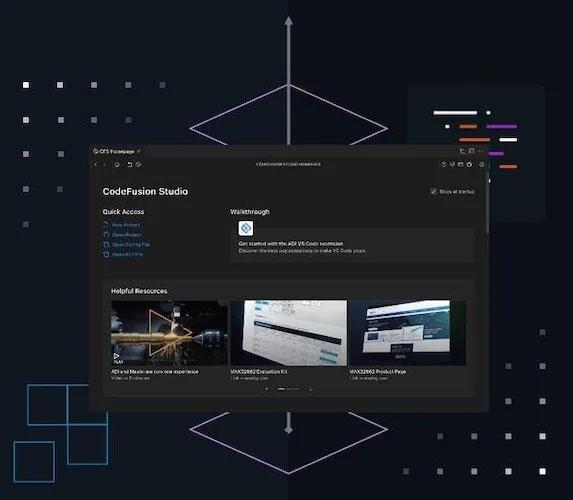
CodeFusion Studio 2.0 brings improved AI workflow and unified development to Analog Devices MCU family.
CodeFusion 2.0's core manager provides a single view and control point for all processors in a system.
CodeFusion 2.0's core manager provides a single view and control point for all processors in a system. (Click on image to enlarge)
CodeFusion Studio 2.0 directly addresses this challenge by integrating all development and debugging workflows into a single, cohesive interface. It provides developers with simultaneous, real-time visibility into all cores—whether CPU, DSP, or MPU. "The unified debug experience gives developers real-time visibility across all cores in one environment," Griffin emphasized. This includes visual tools for configuring memory maps and peripherals, ensuring resources are correctly allocated across the entire system.
A Comprehensive and Cohesive Toolchain
With this release, ADI positions CodeFusion Studio 2.0 as the definitive entry point for all development on its hardware. The update eliminates the fragmentation and setup overhead previously associated with using separate toolchains for different processor cores.
"Everything now lives in a single unified workspace," said Griffin. "You can configure, build, and debug every core from one environment with shared memory maps, peripheral management, and consistent build dependencies."
By combining advanced AI workflows, robust multi-core support, and a deeply integrated environment, ADI intends to significantly reduce the complexity and time associated with building sophisticated embedded systems. CodeFusion Studio 2.0 is now available, offering a more intuitive and powerful path from concept to deployment on the edge.
For further details, visit the official Analog Devices announcement and product page for CodeFusion Studio 2.0.